Filter Comparison#
Comparing effective area curves for various filter combinations.
[1]:
import astropy.units as u
import astropy.constants as const
from astropy.visualization import quantity_support
import matplotlib.pyplot as plt
import numpy as np
from mocksipipeline.detector.response import Channel, ThinFilmFilter, SpectrogramChannel
import xrtpy
[2]:
polymide_thick = ThinFilmFilter(elements=['C','H','N','O'],
                          quantities=[22,10,2,5],
                          density=1.43*u.g/u.cm**3,
                          thickness = 1*u.micron, xrt_table='Chantler')
polymide_thin = ThinFilmFilter(elements=['C','H','N','O'],
                          quantities=[22,10,2,5],
                          density=1.43*u.g/u.cm**3,
                          thickness = 100*u.nm, xrt_table='Chantler')
al_thin = ThinFilmFilter(elements='Al', thickness=150*u.nm, xrt_table='Chantler')
al_thick = ThinFilmFilter(elements='Al', thickness=200*u.nm, xrt_table='Chantler')
Dispersed Channel#
[3]:
configs = [
    al_thin,
    al_thick,
    [al_thin, polymide_thin],
    [al_thick, polymide_thin],
]
[4]:
fig = plt.figure()
ax = fig.add_subplot()
with quantity_support():
    for f in configs:
        chan = SpectrogramChannel(0, f)
        ax.plot(chan.wavelength, chan.effective_area, label=chan.filter_label)
    struc = chan._instrument_data['SAVEGEN0'][chan._data_index]
    ax.plot(struc['WAVE']*u.angstrom, struc['EFFAREA']*u.cm**2, label='0th order from proposal', color='k')
ax.set_yscale('log')
ax.legend()
[4]:
<matplotlib.legend.Legend at 0x11e42bdc0>

Filtergrams#
[5]:
configs = [
    [al_thin, polymide_thick],
    [al_thick, polymide_thick],
    [ThinFilmFilter('Be', thickness=9*u.micron)],
    [ThinFilmFilter('Be', thickness=30*u.micron)],
    [ThinFilmFilter('Be', thickness=300*u.micron)],
]
[6]:
eaf = xrtpy.response.EffectiveAreaFundamental('Al_poly', '2020-01-01')
[7]:
fig = plt.figure()
ax = fig.add_subplot()
with quantity_support():
    for f in configs:
        chan = Channel('filtergram_1', f)
        ax.plot(chan.wavelength, chan.effective_area, label=chan.filter_label)
    struc = chan._instrument_data['SAVEGEN0'][chan._index_mapping['Al_poly']]
    # from MOXSI proposal
    ax.plot(struc['WAVE']*u.angstrom, struc['EFFAREA']*u.cm**2, label='Al poly from proposal', color='k')
ax.set_yscale('log')
ax.set_ylim(1e-10,3e-5)
ax.set_title('Filtergram Choices')
ax.legend()
[7]:
<matplotlib.legend.Legend at 0x11e888fa0>

The plot below shows just the filter transmission and compares it with the Al-poly channel on XRT. We have extended the response out to 150 Å to understand how longer wavelengths will respond to our bandpass as well which is important for the 0th order (and the filtergrams).
[14]:
def combine_filter_transmission(filters, wavelength):
    energy = const.h * const.c / wavelength
    ft = u.Quantity(np.ones(energy.shape))
    for f in filters:
        ft *= f.transmissivity(energy)
    return ft
[15]:
wavelength = np.arange(.5, 150, 0.055) * u.Angstrom
[16]:
fig = plt.figure()
ax = fig.add_subplot()
with quantity_support():
    for f in configs:
        chan = Channel('filtergram_1', f)
        trans = combine_filter_transmission(f, wavelength)
        ax.plot(wavelength, trans, label=chan.filter_label)
    struc = chan._instrument_data['SAVEGEN0'][chan._index_mapping['Al_poly']]
    # from MOXSI proposal
    ax.plot(struc['WAVE']*u.angstrom, struc['FILTER'], label='Al poly from proposal', color='k')
    # from xrtpy
    xrt_filter = xrtpy.response.Channel('Al-poly').filter_1
    ax.plot(xrt_filter.filter_wavelength, xrt_filter.filter_transmission, label='XRT Al-Poly')
ax.set_yscale('log')
ax.set_ylim(1e-10,5)
ax.set_xlim(wavelength[[0,-1]])
ax.set_title('Filtergram Choices')
ax.legend()
[16]:
<matplotlib.legend.Legend at 0x11eea7340>

Filter Summary#
The figure below puts all of the channels, for both the filtergrams and the dispersed channels, on the same plot for our current conception of the filter designs.
[4]:
filtergrams = [
    Channel('filtergram_1', [ThinFilmFilter('Be', thickness=8*u.micron, xrt_table='Chantler')]),
    Channel('filtergram_2', [ThinFilmFilter('Be', thickness=30*u.micron, xrt_table='Chantler')]),
    Channel('filtergram_3', [ThinFilmFilter('Be', thickness=350*u.micron, xrt_table='Chantler')]),
    Channel('filtergram_4', [polymide_thick, al_thin]),
]
dispersed_channels = [
    SpectrogramChannel(0, [al_thin]),
    SpectrogramChannel(1, [al_thin]),
    SpectrogramChannel(3, [al_thin]),
]
[5]:
fig = plt.figure(figsize=(12,5))
ax = fig.add_subplot()
for f in filtergrams:
    ax.plot(f.wavelength, f.effective_area, label='Al poly' if 'Al' in f.filter_label else f.filter_label)
for f in dispersed_channels:
    ax.plot(f.wavelength, f.effective_area, label=f'order={f.spectral_order}', ls=':')
ax.set_yscale('log')
ax.set_ylim(1e-10,2e-5)
ax.set_xlim(1,60)
ax.legend(bbox_to_anchor=(.5,1.05), loc='center', ncol=7,frameon=False)
ax.set_xlabel('Wavelength [Å]')
ax.set_ylabel('Effective Area [cm$^2$]')
/Users/wtbarnes/mambaforge/envs/mocksipipeline/lib/python3.9/site-packages/astropy/units/quantity.py:626: RuntimeWarning: divide by zero encountered in divide
  result = super().__array_ufunc__(function, method, *arrays, **kwargs)
/Users/wtbarnes/mambaforge/envs/mocksipipeline/lib/python3.9/site-packages/astropy/units/quantity.py:626: RuntimeWarning: divide by zero encountered in divide
  result = super().__array_ufunc__(function, method, *arrays, **kwargs)
[5]:
Text(0, 0.5, 'Effective Area [cm$^2$]')

Detector Efficiency#
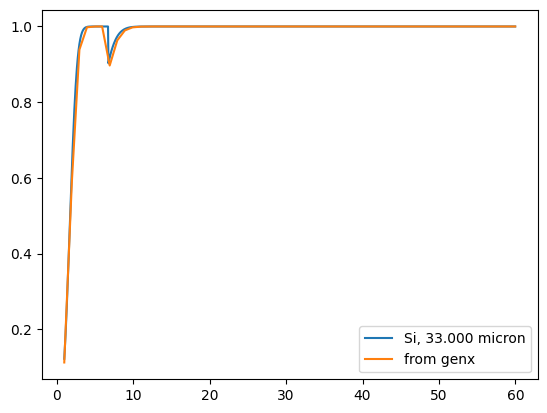
Below, I’m just doing a few experiements to try to understand how the detector efficiency was modeled. It appears that it is just the absorption in Si for some particular thickness and interpolated poorly to a wavelength array corresponding to the bandpass. I still do not understand why the thickness is approximately 33 microns.
[19]:
si_thinfilm = ThinFilmFilter('Si', thickness=33*u.micron)
[20]:
si_trans = si_thinfilm.transmissivity(const.h * const.c / chan.wavelength)
si_absor = 1-si_trans
plt.plot(chan.wavelength,si_absor, label=Channel('filtergram_1',si_thinfilm).filter_label)
plt.plot(struc['WAVE'], struc['DET'], label='from genx')
plt.legend()
[20]:
<matplotlib.legend.Legend at 0x11fdfa4f0>
[21]:
si_thinfilm.density_normalized.to('g cm-3')
[21]:
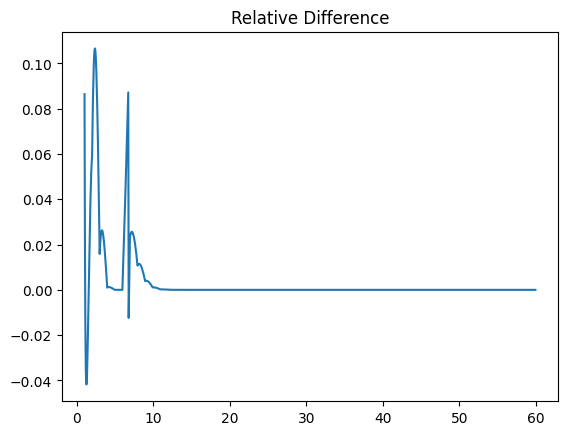
This model clearly differs a bit from what is stored in that file, but it is not clear to what extent this is just due to interpolation (and maybe a poor estimate of what type of material is used).
[23]:
plt.plot(chan.wavelength, si_absor / struc['DET'] - 1)
plt.title('Relative Difference')
[23]:
Text(0.5, 1.0, 'Relative Difference')
[ ]: