[1]:
import numpy as np
import astropy.units as u
import astropy.table
import astropy.io.fits
import plasmapy
import pathlib
import matplotlib.pyplot as plt

from astropy.coordinates import SkyCoord
from astropy.convolution import convolve, Gaussian1DKernel
import ndcube
from ndcube.extra_coords import QuantityTableCoordinate
import fiasco
import aiapy.response
from sunpy.coordinates import get_earth, Helioprojective

from fiasco.io import Parser
from fiasco.util import parse_ion_name
from synthesizAR.instruments import InstrumentDEM

from mocksipipeline.physics.spectral import get_spectral_tables
from mocksipipeline.detector.response import SpectrogramChannel, convolve_with_response, ThinFilmFilter
from overlappy.wcs import overlappogram_fits_wcs, pcij_matrix
Spectral Decomposition#
Break down the MOXSI spectra into components based on element and ion
[2]:
line_list = astropy.table.QTable.read('../data/moxsi-line-list.asdf')
WARNING: UnitsWarning: The unit 'Angstrom' has been deprecated in the VOUnit standard. Suggested: 0.1nm. [astropy.units.format.utils]
[3]:
unique_elements = np.unique(line_list['element'])
Components in Flux#
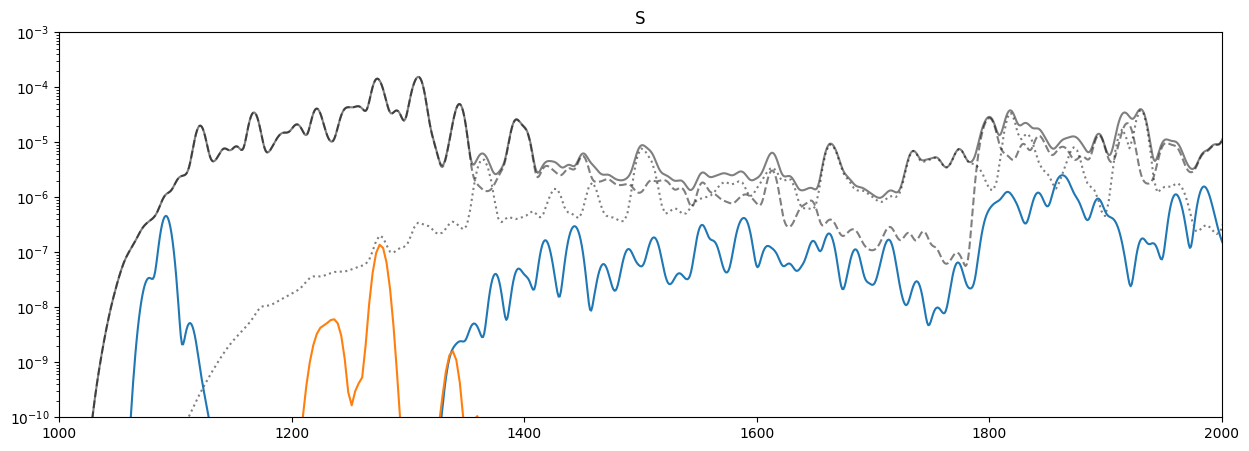
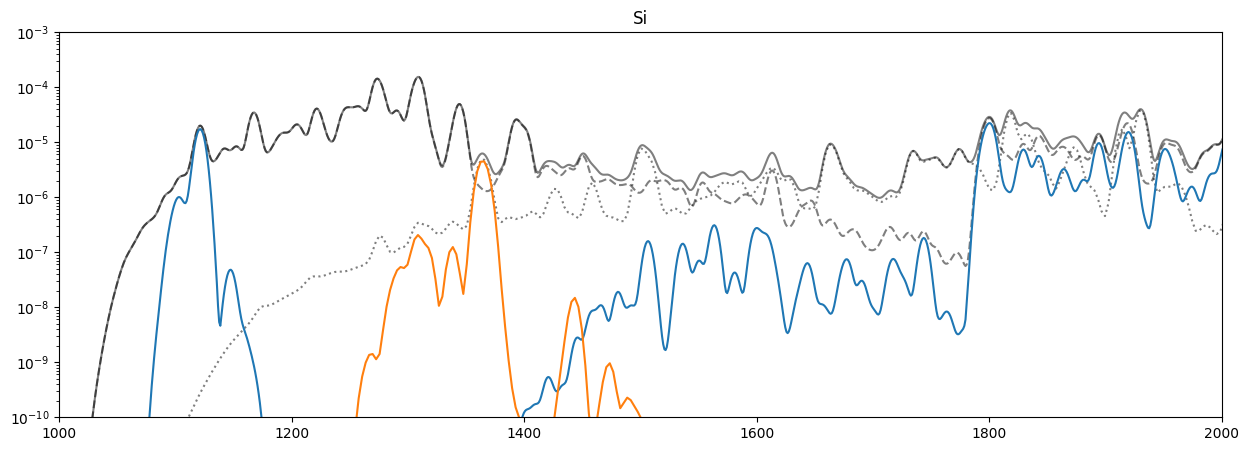
Look at the invididual components of the total flux to determine which elements are contributing most and where. This may help pin down the above issue of what lines are the most dominant/important
[4]:
def dem_table_to_ndcube(dem_table):
    temperature = dem_table['temperature_bin_center']
    em = dem_table['dem']*np.gradient(temperature, edge_order=2)
    tab_coord = QuantityTableCoordinate(temperature,
                                        names='temperature',
                                        physical_types='phys.temperature')
    return ndcube.NDCube(em, wcs=tab_coord.wcs, meta=dem_table.meta)
[5]:
def compute_total_flux(dem, spec_table, chan_1, chan_3, x_1, x_3):
    intensity = InstrumentDEM.calculate_intensity(dem, spec_table, {})
    flux_1 = convolve_with_response(intensity, chan_1, electrons=False, include_gain=False)
    flux_3 = convolve_with_response(intensity, chan_3, electrons=False, include_gain=False)
    flux_total = ndcube.NDCube(flux_1.data+np.interp(x_1, x_3, flux_3.data),
                               wcs=flux_1.wcs, unit=flux_1.unit)
    return flux_1, flux_3, flux_total
[6]:
def degrade_spectra(spec, resolution, chan):
    std = resolution / (2*np.sqrt(2*np.log(2)))  # FWHM is 0.5 so convert to sigma using W = 2\sqrt{2\ln2}\sigma
    std_eff = (std / chan.spectral_resolution).to_value('pix')  # Scale sigma by bin width
    kernel = Gaussian1DKernel(std_eff)
    data_smooth = convolve(spec.data, kernel)
    return ndcube.NDCube(data_smooth, wcs=spec.wcs, meta=spec.meta, unit=spec.unit)
[7]:
dem_flare_ext = dem_table_to_ndcube(Parser('flare_ext.dem', ascii_dbase_root='/Users/wtbarnes/ssw/packages/chianti/dbase/').parse())
[8]:
dem_ar = dem_table_to_ndcube(Parser('active_region.dem', ascii_dbase_root='/Users/wtbarnes/ssw/packages/chianti/dbase/').parse())
[9]:
ascii_dbase = '/Users/wtbarnes/ssw/packages/chianti/dbase/'
abundance_file_coronal = 'sun_coronal_1992_feldman_ext.abund'
abundance_file_photospheric = 'sun_photospheric_2015_scott.abund'
coronal_abundance_table = fiasco.io.Parser(abundance_file_coronal, ascii_dbase_root=ascii_dbase).parse()
photospheric_abundance_table = fiasco.io.Parser(abundance_file_photospheric, ascii_dbase_root=ascii_dbase).parse()
[10]:
spec_tables = get_spectral_tables()
WARNING: UnitsWarning: The unit 'Angstrom' has been deprecated in the VOUnit standard. Suggested: 0.1nm. [astropy.units.format.utils]
WARNING: AstropyDeprecationWarning: The truth value of a Quantity is ambiguous. In the future this will raise a ValueError. [astropy.units.quantity]
[11]:
al_filter = ThinFilmFilter(elements='Al', thickness=150*u.nm, xrt_table='Chantler')
chan_o1 = SpectrogramChannel(1, al_filter)
chan_o3 = SpectrogramChannel(3, al_filter)
[12]:
earth_observer = get_earth(time='2020-01-01 12:00:00')
flare_loc = SkyCoord(Tx=-900*u.arcsec, Ty=0*u.arcsec,
                     frame=Helioprojective(obstime=earth_observer.obstime, observer=earth_observer))
roll_angle = -90 * u.deg
dispersion_angle = 0*u.deg
wcs_o1 = overlappogram_fits_wcs(
    chan_o1.detector_shape,
    chan_o1.wavelength,
    (chan_o1.resolution[0], chan_o1.resolution[1], chan_o1.spectral_resolution),
    reference_pixel=chan_o1.reference_pixel,
    reference_coord=(0*u.arcsec, 0*u.arcsec, 0*u.angstrom),
    pc_matrix=pcij_matrix(roll_angle, dispersion_angle, order=chan_o1.spectral_order,),
    observer=earth_observer,
)
wcs_o3 = overlappogram_fits_wcs(
    chan_o3.detector_shape,
    chan_o3.wavelength,
    (chan_o3.resolution[0], chan_o3.resolution[1], chan_o3.spectral_resolution),
    reference_pixel=chan_o3.reference_pixel,
    reference_coord=(0*u.arcsec, 0*u.arcsec, 0*u.angstrom),
    pc_matrix=pcij_matrix(roll_angle, dispersion_angle, order=chan_o3.spectral_order,),
    observer=earth_observer,
)
pix_x_o1, _, _ = wcs_o1.world_to_pixel(flare_loc, chan_o1.wavelength)
pix_x_o3, _, _ = wcs_o3.world_to_pixel(flare_loc, chan_o3.wavelength)
WARNING: FITSFixedWarning: 'datfix' made the change 'Set MJD-OBS to 58849.500000 from DATE-OBS'. [astropy.wcs.wcs]
WARNING: FITSFixedWarning: 'unitfix' made the change 'Changed units:
  'angstrom' -> 'Angstrom'. [astropy.wcs.wcs]
WARNING: No observer defined on WCS, SpectralCoord will be converted without any velocity frame change [astropy.wcs.wcsapi.fitswcs]
Flare DEM#
Components#
[13]:
flux_1_all,flux_3_all,flux_total_all = compute_total_flux(dem_flare_ext, spec_tables['sun_coronal_1992_feldman_ext_all'], chan_o1, chan_o3, pix_x_o1, pix_x_o3)
blur = 0.5 * u.Angstrom
flux_1_all = degrade_spectra(flux_1_all, blur, chan_o1)
flux_3_all = degrade_spectra(flux_3_all, blur/3, chan_o1)
flux_total_all = degrade_spectra(flux_total_all, blur, chan_o1)
for el_name in unique_elements:
    spec_tab = get_spectral_tables(pattern=f'{el_name.lower()}_', sum_tables=True)
    fig = plt.figure(figsize=(15,5))
    ax = fig.add_subplot()
    ax.plot(pix_x_o1, flux_total_all.data, color='k', alpha=.5)
    ax.plot(pix_x_o1, flux_1_all.data, color='k', alpha=.5, ls='--')
    ax.plot(pix_x_o3, flux_3_all.data, color='k', alpha=.5, ls=':')
    ab = fiasco.Element(el_name, 1*u.MK, abundance_filename='sun_coronal_1992_feldman_ext').abundance
    f1,f3,_ = compute_total_flux(dem_flare_ext, spec_tab, chan_o1, chan_o3, pix_x_o1, pix_x_o3)
    f1 = degrade_spectra(f1, blur, chan_o1)
    f3 = degrade_spectra(f3, blur/3, chan_o1)
    f1 = ab*f1
    f3 = ab*f3
    ax.plot(pix_x_o1, f1.data)
    ax.plot(pix_x_o3, f3.data)
    ax.set_yscale('log')
    ax.set_ylim(1e-5,5)
    ax.set_title(el_name)
    ax.set_xlim(1000,2000)
/Users/wtbarnes/mambaforge/envs/mocksipipeline/lib/python3.9/site-packages/astropy/units/quantity.py:626: RuntimeWarning: divide by zero encountered in divide
  result = super().__array_ufunc__(function, method, *arrays, **kwargs)
/Users/wtbarnes/mambaforge/envs/mocksipipeline/lib/python3.9/site-packages/astropy/units/quantity.py:626: RuntimeWarning: divide by zero encountered in divide
  result = super().__array_ufunc__(function, method, *arrays, **kwargs)
WARNING: UnitsWarning: The unit 'Angstrom' has been deprecated in the VOUnit standard. Suggested: 0.1nm. [astropy.units.format.utils]
WARNING: AstropyDeprecationWarning: The truth value of a Quantity is ambiguous. In the future this will raise a ValueError. [astropy.units.quantity]


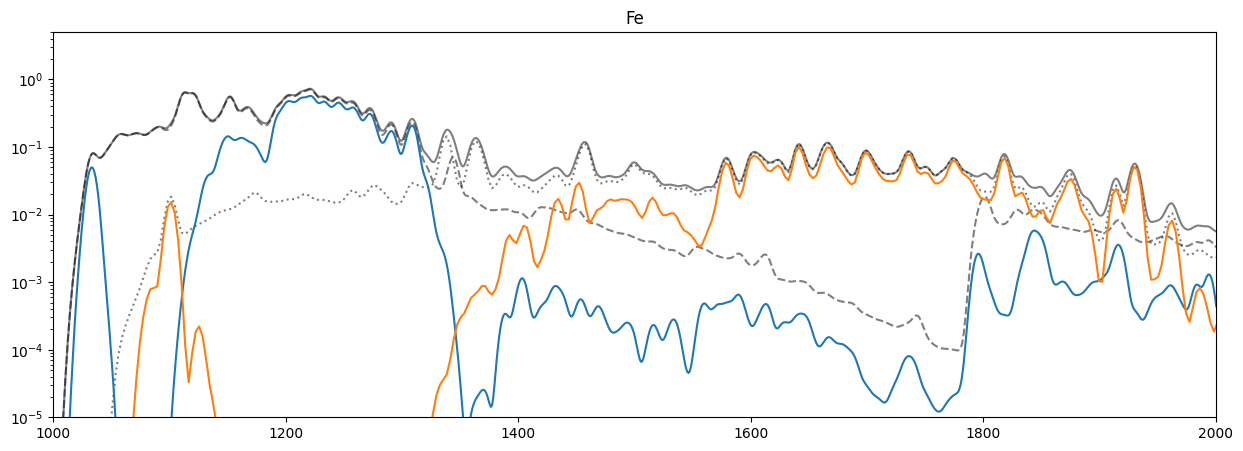

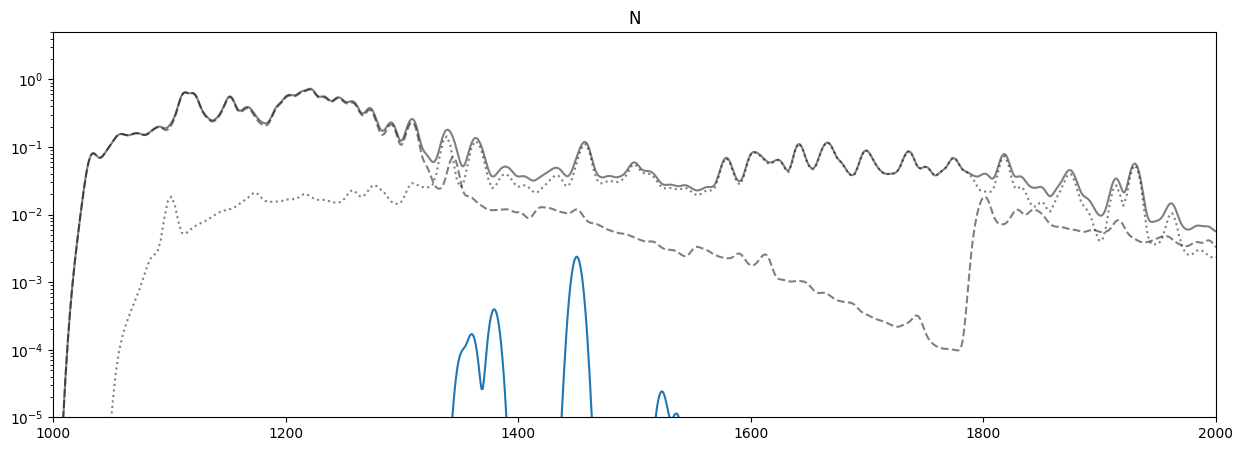
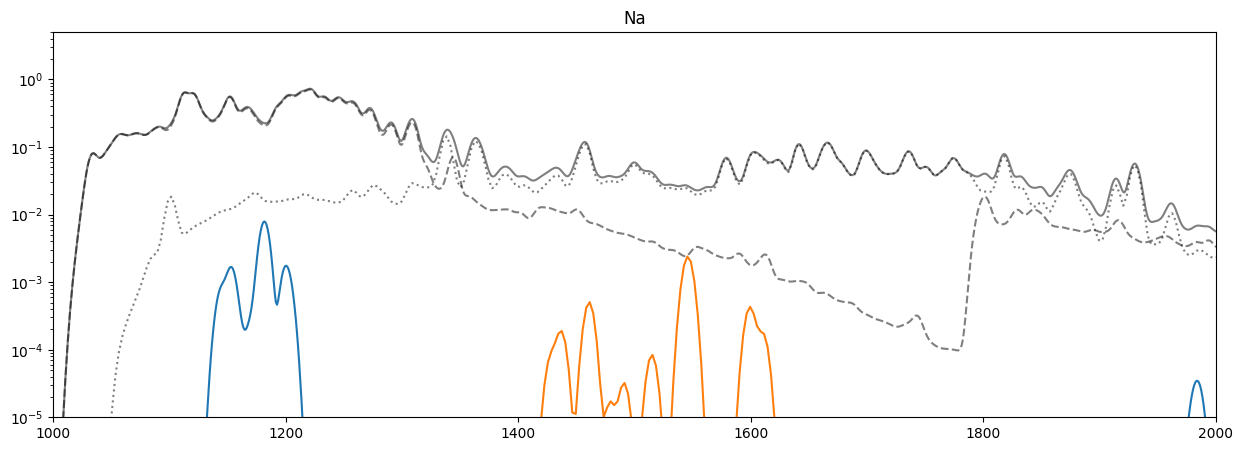
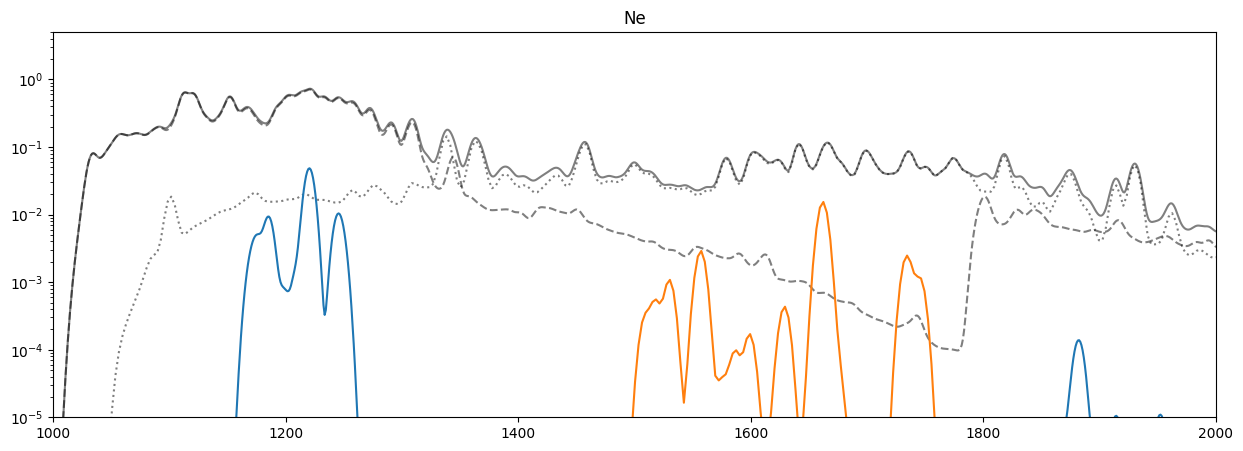
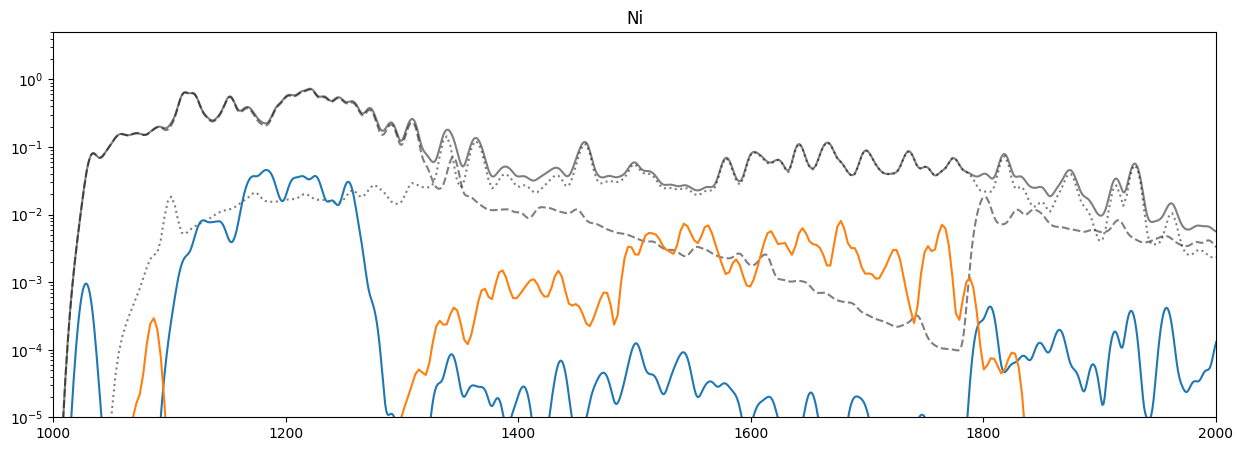
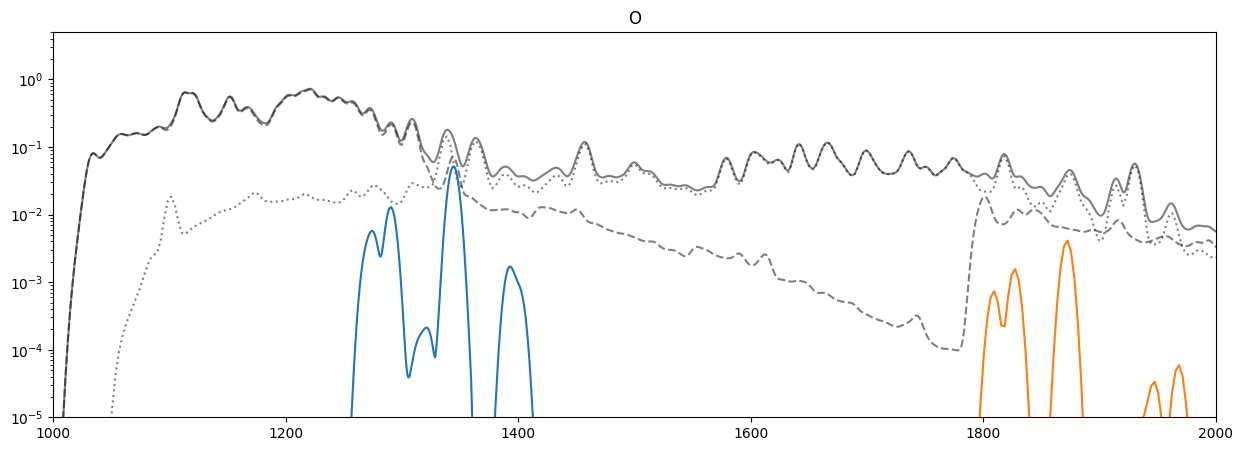
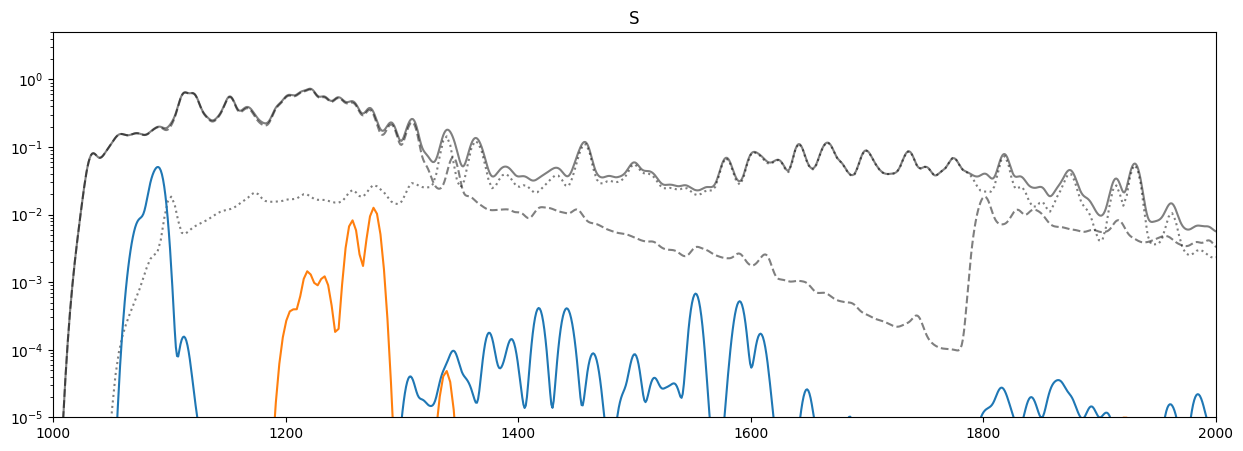
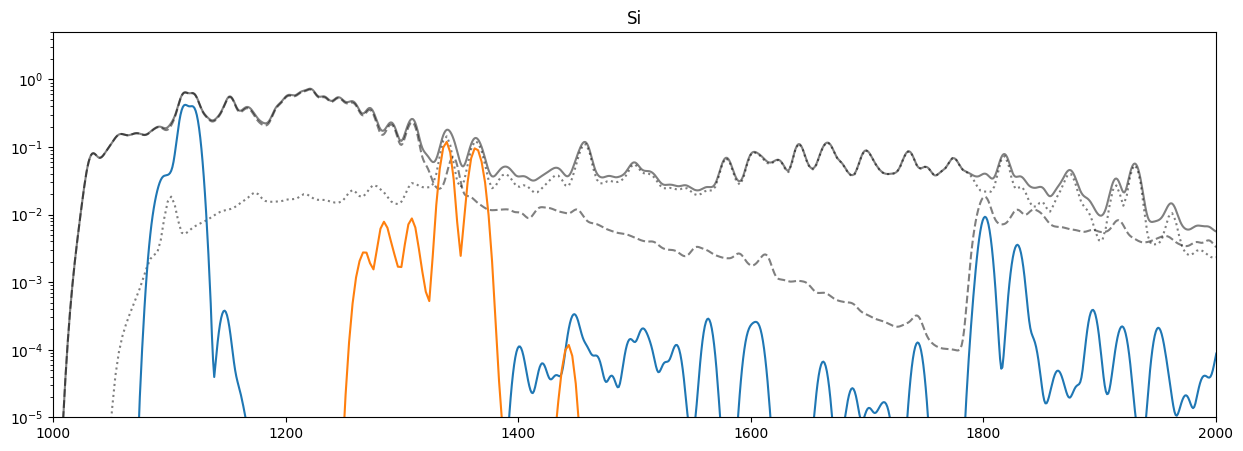
Combined#
[14]:
blur = 0.5 * u.angstrom
[37]:
flare_line_labels = line_list[line_list['intensity_scaled (coronal)_flare_ext']>0.1]
flare_line_labels = flare_line_labels[['ion name', 'wavelength', 'ion id']]
[38]:
flux_1_all,flux_3_all,flux_total_all = compute_total_flux(dem_flare_ext, spec_tables['sun_coronal_1992_feldman_ext_all'], chan_o1, chan_o3, pix_x_o1, pix_x_o3)
fig = plt.figure(figsize=(20,5))
ax = fig.add_subplot()
ax.plot(pix_x_o1, degrade_spectra(flux_total_all, blur, chan_o1).data, color='k', alpha=.5)
total_components = ndcube.NDCube(np.zeros(pix_x_o1.shape), wcs=flux_total_all.wcs, unit=flux_total_all.unit)
for el_name in unique_elements:
    spec_tab = get_spectral_tables(pattern=f'{el_name.lower()}_', sum_tables=True)
    ab = fiasco.Element(el_name, 1*u.MK, abundance_filename='sun_coronal_1992_feldman_ext').abundance
    f1,f3,fall = compute_total_flux(dem_flare_ext, spec_tab, chan_o1, chan_o3, pix_x_o1, pix_x_o3)
    f1 = ab*f1
    f3 = ab*f3
    fall = ab*fall
    total_components += fall.data * fall.unit
    ax.plot(pix_x_o1, degrade_spectra(fall, blur, chan_o1).data, label=el_name.capitalize())
ax.plot(pix_x_o1, degrade_spectra(total_components, blur, chan_o1).data, color='k', ls='--')

# Add vertical lines denoting lines
order_1_color = 'blue'
order_3_color = 'red'
x_pos_1,_,_ = wcs_o1.world_to_pixel(flare_loc, flare_line_labels['wavelength'])
x_pos_3,_,_ = wcs_o3.world_to_pixel(flare_loc, flare_line_labels['wavelength'])
ax.vlines(x_pos_1, 0, 1, ls=':', color=order_1_color,)
ax.vlines(x_pos_3, 0, 1, ls=':', color=order_3_color,)
# Add tick labels for lines
tick_labels = [f'{row["ion name"]}, {row["wavelength"].to_string(format="latex_inline")}' for row in flare_line_labels]
ax_top = ax.secondary_xaxis('top')
ax_top.set_xticks(np.hstack([x_pos_1, x_pos_3]),
                  labels=tick_labels+tick_labels,
                  rotation=90,
                  horizontalalignment='center',
                  color=order_1_color);
for i,tick in enumerate(ax_top.get_xticklabels()):
    if i>=len(tick_labels):
        tick.set_color(order_3_color)

ax.set_yscale('log')
ax.set_ylim(1e-4,1)
#    ax.set_title(el_name.capitalize())
ax.set_xlim(1000,2000)
#ax.legend(ncol=2)
[38]:
(1000.0, 2000.0)

This next plot looks at the breakdown by ion rather than element.
[39]:
label_lines = True
flux_1_all,flux_3_all,flux_total_all = compute_total_flux(dem_flare_ext, spec_tables['sun_coronal_1992_feldman_ext_all'], chan_o1, chan_o3, pix_x_o1, pix_x_o3)
fig = plt.figure(figsize=(20,6))
ax = fig.add_subplot()
ax.plot(pix_x_o1, degrade_spectra(flux_total_all, blur, chan_o1).data, color='k', alpha=.5)
total_components = ndcube.NDCube(np.zeros(pix_x_o1.shape), wcs=flux_total_all.wcs, unit=flux_total_all.unit)
for ion_name in np.unique(flare_line_labels['ion id']):
    spec_tab = get_spectral_tables(pattern=f'{ion_name}', sum_tables=True)
    ab = fiasco.Element(ion_name.split('_')[0], 1*u.MK, abundance_filename='sun_coronal_1992_feldman_ext').abundance
    f1,f3,fall = compute_total_flux(dem_flare_ext, spec_tab, chan_o1, chan_o3, pix_x_o1, pix_x_o3)
    f1 = ab*f1
    f3 = ab*f3
    fall = ab*fall
    total_components += fall.data * fall.unit
    ax.plot(pix_x_o1, degrade_spectra(fall, blur, chan_o1).data, label=ion_name.capitalize())
ax.plot(pix_x_o1, degrade_spectra(total_components, blur, chan_o1).data, color='k', ls='--')

# Add vertical lines denoting lines
order_1_color = 'blue'
order_3_color = 'red'
x_pos_1,_,_ = wcs_o1.world_to_pixel(flare_loc, flare_line_labels['wavelength'])
x_pos_3,_,_ = wcs_o3.world_to_pixel(flare_loc, flare_line_labels['wavelength'])
ax.vlines(x_pos_1, 0, 1, ls=':', color=order_1_color,)
ax.vlines(x_pos_3, 0, 1, ls=':', color=order_3_color,)
# Add tick labels for lines
tick_labels = [f'{row["ion name"]}, {row["wavelength"].to_string(format="latex_inline")}' for row in flare_line_labels]
ax_top = ax.secondary_xaxis('top')
ax_top.set_xticks(np.hstack([x_pos_1, x_pos_3]),
                  labels=tick_labels+tick_labels,
                  rotation=90,
                  horizontalalignment='center',
                  color=order_1_color);
for i,tick in enumerate(ax_top.get_xticklabels()):
    if i>=len(tick_labels):
        tick.set_color(order_3_color)

#ax.set_yscale('log')
ax.set_ylim(1e-4,1)
#    ax.set_title(el_name.capitalize())
ax.set_xlim(1000,2000)
ax.legend(ncol=10, bbox_to_anchor=(0.5, -0.3), loc='lower center')
[39]:
<matplotlib.legend.Legend at 0x2fdf2f520>

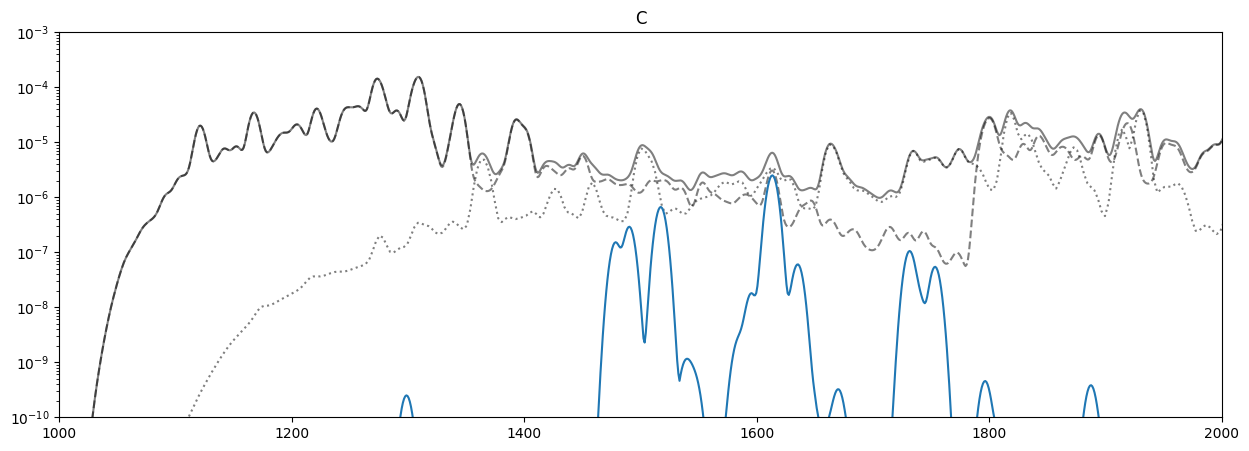
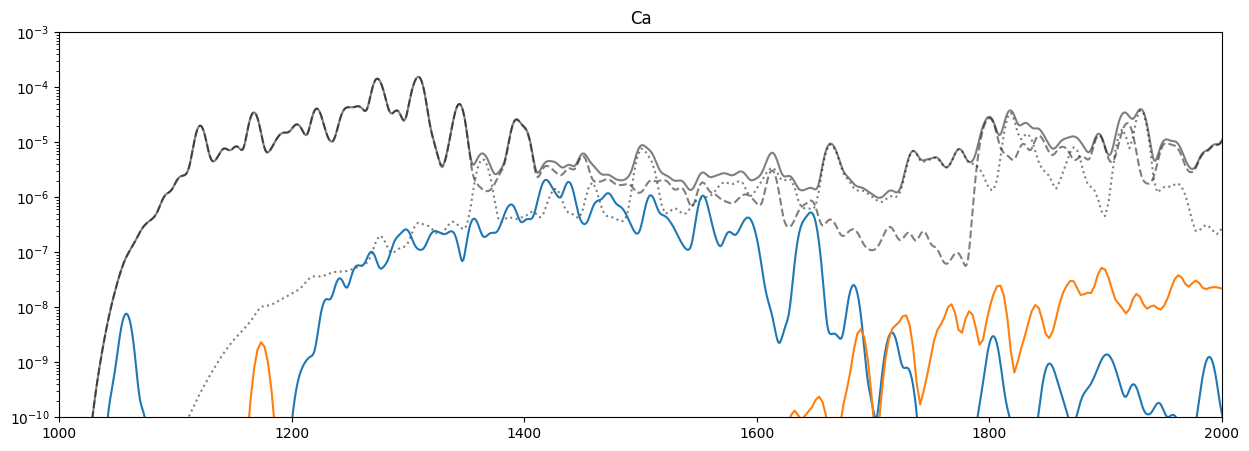
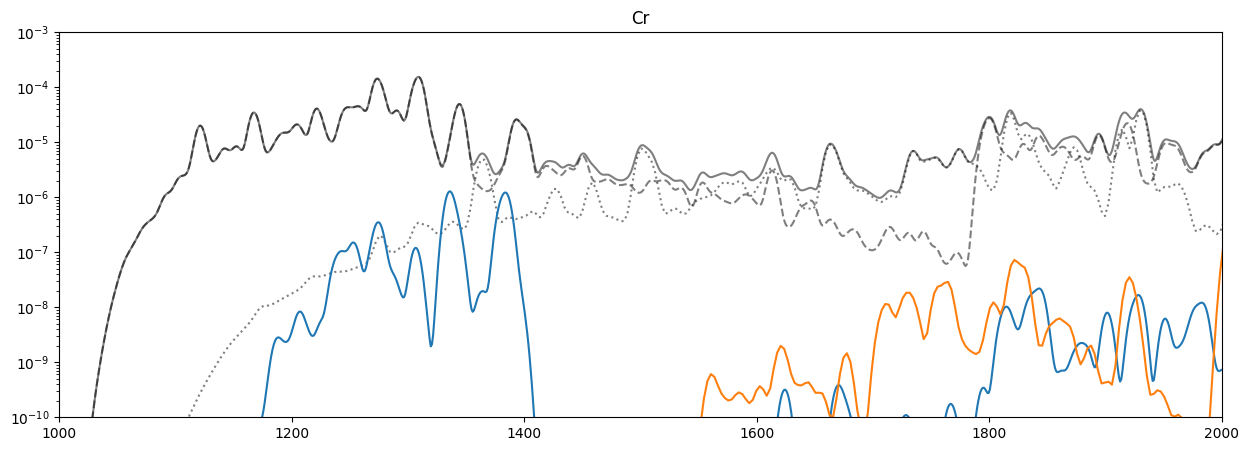
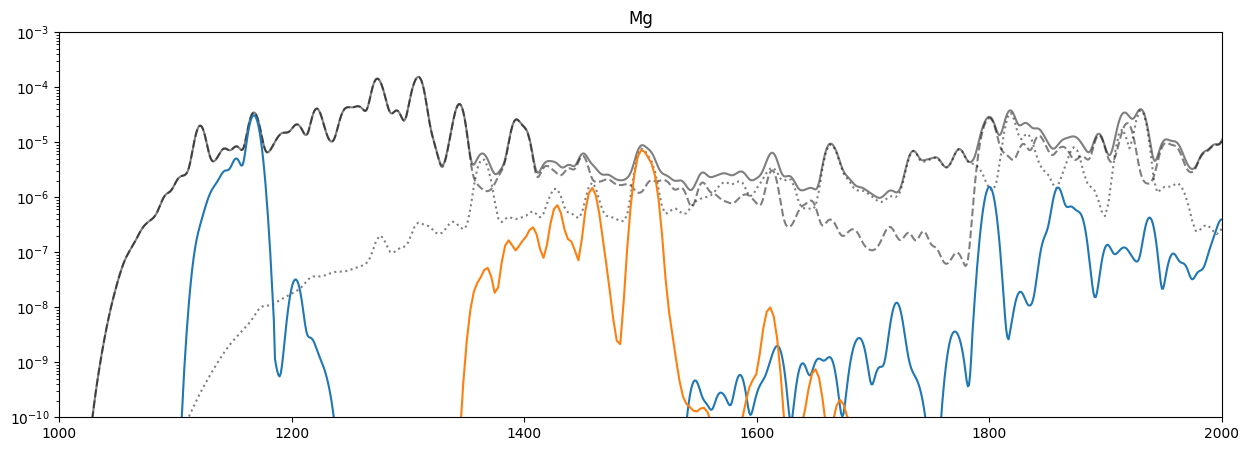
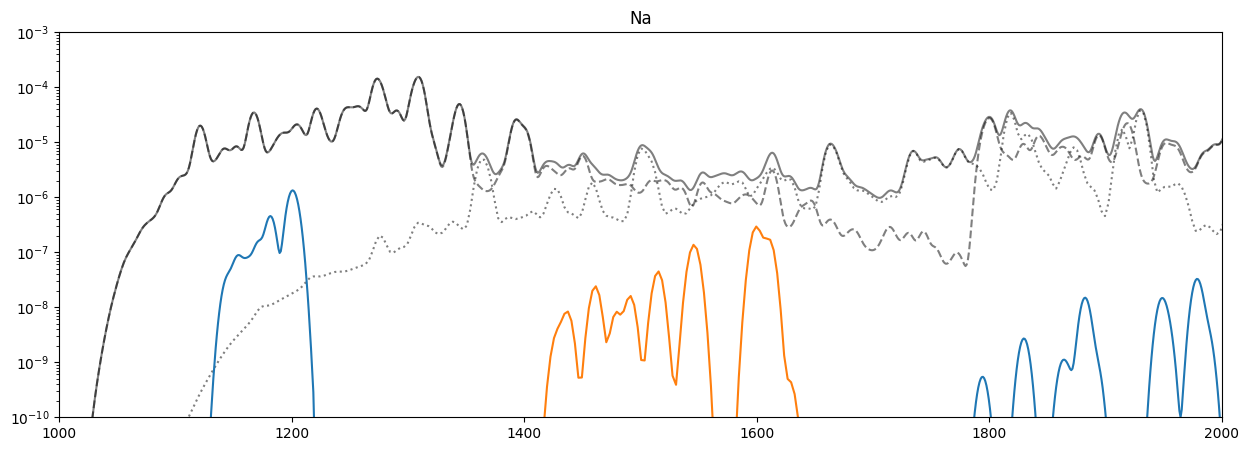
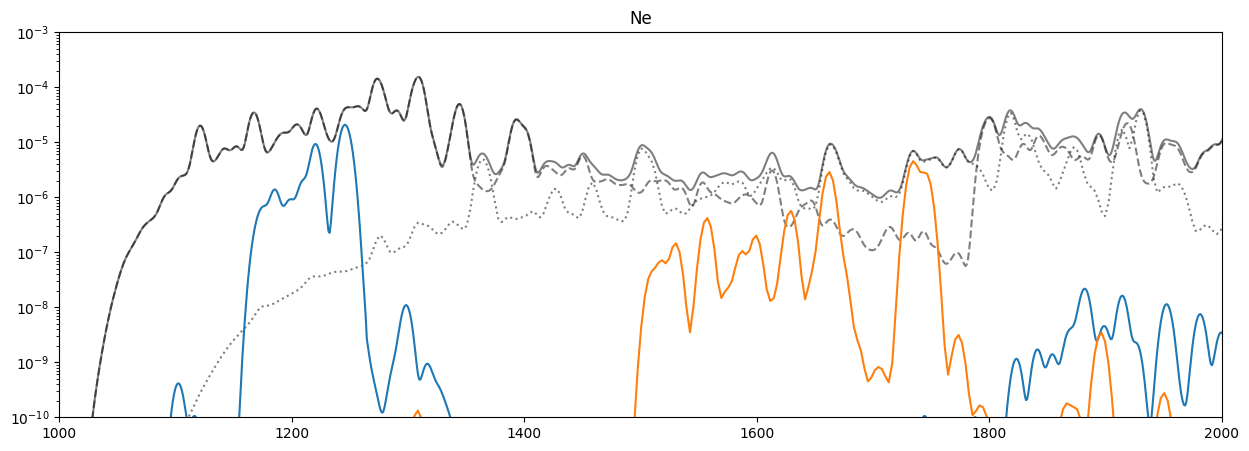
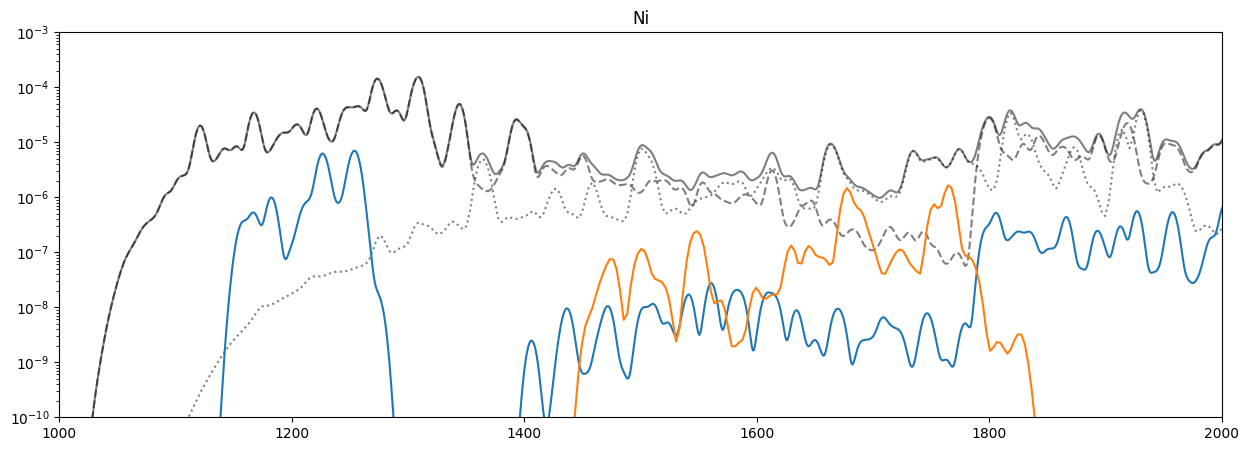
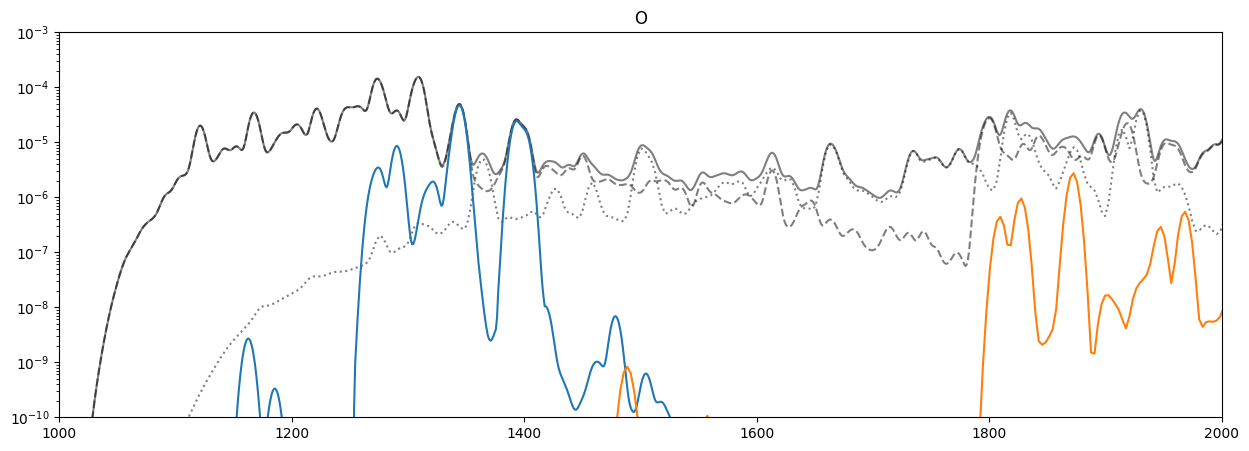
Active Region DEM#
Components#
[41]:
flux_1_all,flux_3_all,flux_total_all = compute_total_flux(dem_ar, spec_tables['sun_coronal_1992_feldman_ext_all'], chan_o1, chan_o3, pix_x_o1, pix_x_o3)
blur = 0.5 * u.Angstrom
flux_1_all = degrade_spectra(flux_1_all, blur, chan_o1)
flux_3_all = degrade_spectra(flux_3_all, blur/3, chan_o1)
flux_total_all = degrade_spectra(flux_total_all, blur, chan_o1)
for el_name in unique_elements:
    spec_tab = get_spectral_tables(pattern=f'{el_name.lower()}_', sum_tables=True)
    fig = plt.figure(figsize=(15,5))
    ax = fig.add_subplot()
    ax.plot(pix_x_o1, flux_total_all.data, color='k', alpha=.5)
    ax.plot(pix_x_o1, flux_1_all.data, color='k', alpha=.5, ls='--')
    ax.plot(pix_x_o3, flux_3_all.data, color='k', alpha=.5, ls=':')
    ab = fiasco.Element(el_name, 1*u.MK, abundance_filename='sun_coronal_1992_feldman_ext').abundance
    f1,f3,_ = compute_total_flux(dem_ar, spec_tab, chan_o1, chan_o3, pix_x_o1, pix_x_o3)
    f1 = degrade_spectra(f1, blur, chan_o1)
    f3 = degrade_spectra(f3, blur/3, chan_o1)
    f1 = ab*f1
    f3 = ab*f3
    ax.plot(pix_x_o1, f1.data)
    ax.plot(pix_x_o3, f3.data)
    ax.set_yscale('log')
    ax.set_ylim(1e-10,1e-3)
    ax.set_title(el_name.capitalize())
    ax.set_xlim(1000,2000)
WARNING: AstropyDeprecationWarning: The truth value of a Quantity is ambiguous. In the future this will raise a ValueError. [astropy.units.quantity]




Combined#
[290]:
blur = 0.5 * u.angstrom
[53]:
ar_line_labels = line_list[line_list['intensity_scaled (coronal)_active_region']>0.05]
ar_line_labels = ar_line_labels[['ion name', 'wavelength', 'ion id']]
[54]:
flux_1_all,flux_3_all,flux_total_all = compute_total_flux(dem_ar, spec_tables['sun_coronal_1992_feldman_ext_all'], chan_o1, chan_o3, pix_x_o1, pix_x_o3)
fig = plt.figure(figsize=(20,5))
ax = fig.add_subplot()
ax.plot(pix_x_o1, degrade_spectra(flux_total_all, blur, chan_o1).data, color='k', alpha=.5)
total_components = ndcube.NDCube(np.zeros(pix_x_o1.shape), wcs=flux_total_all.wcs, unit=flux_total_all.unit)
for el_name in ['s', 'mg', 'fe', 'si', 'o', 'ne', 'ca', 'al', 'ar', 'c', 'n']:
    spec_tab = get_spectral_tables(pattern=f'{el_name}_', sum_tables=True)
    ab = fiasco.Element(el_name, 1*u.MK, abundance_filename='sun_coronal_1992_feldman_ext').abundance
    f1,f3,fall = compute_total_flux(dem_ar, spec_tab, chan_o1, chan_o3, pix_x_o1, pix_x_o3)
    f1 = ab*f1
    f3 = ab*f3
    fall = ab*fall
    total_components += fall.data * fall.unit
    ax.plot(pix_x_o1, degrade_spectra(fall, blur, chan_o1).data, label=el_name.capitalize())
ax.plot(pix_x_o1, degrade_spectra(total_components, blur, chan_o1).data, color='k', ls='--')

# Add vertical lines denoting lines
order_1_color = 'blue'
order_3_color = 'red'
x_pos_1,_,_ = wcs_o1.world_to_pixel(flare_loc, ar_line_labels['wavelength'])
x_pos_3,_,_ = wcs_o3.world_to_pixel(flare_loc, ar_line_labels['wavelength'])
ax.vlines(x_pos_1, 0, 1, ls=':', color=order_1_color,)
ax.vlines(x_pos_3, 0, 1, ls=':', color=order_3_color,)
# Add tick labels for lines
tick_labels = [f'{row["ion name"]}, {row["wavelength"].to_string(format="latex_inline")}' for row in ar_line_labels]
ax_top = ax.secondary_xaxis('top')
ax_top.set_xticks(np.hstack([x_pos_1, x_pos_3]),
                  labels=tick_labels+tick_labels,
                  rotation=90,
                  horizontalalignment='center',
                  color=order_1_color);
for i,tick in enumerate(ax_top.get_xticklabels()):
    if i>=len(tick_labels):
        tick.set_color(order_3_color)

ax.set_yscale('log')
ax.set_ylim(1e-10,1e-3)
ax.set_xlim(1000,2000)
ax.legend(ncol=2)
[54]:
<matplotlib.legend.Legend at 0x2fd1dd1c0>

[55]:
flux_1_all,flux_3_all,flux_total_all = compute_total_flux(dem_ar, spec_tables['sun_coronal_1992_feldman_ext_all'], chan_o1, chan_o3, pix_x_o1, pix_x_o3)
fig = plt.figure(figsize=(20,6))
ax = fig.add_subplot()
ax.plot(pix_x_o1, degrade_spectra(flux_total_all, blur, chan_o1).data, color='k', alpha=.5)
total_components = ndcube.NDCube(np.zeros(pix_x_o1.shape), wcs=flux_total_all.wcs, unit=flux_total_all.unit)
for ion_name in np.unique(ar_line_labels['ion id']):
    spec_tab = get_spectral_tables(pattern=f'{ion_name}', sum_tables=True)
    ab = fiasco.Element(ion_name.split('_')[0], 1*u.MK, abundance_filename='sun_coronal_1992_feldman_ext').abundance
    f1,f3,fall = compute_total_flux(dem_ar, spec_tab, chan_o1, chan_o3, pix_x_o1, pix_x_o3)
    f1 = ab*f1
    f3 = ab*f3
    fall = ab*fall
    total_components += fall.data * fall.unit
    ax.plot(pix_x_o1, degrade_spectra(fall, blur, chan_o1).data, label=ion_name.capitalize())
ax.plot(pix_x_o1, degrade_spectra(total_components, blur, chan_o1).data, color='k', ls='--')

# Add vertical lines denoting lines
order_1_color = 'blue'
order_3_color = 'red'
x_pos_1,_,_ = wcs_o1.world_to_pixel(flare_loc, ar_line_labels['wavelength'])
x_pos_3,_,_ = wcs_o3.world_to_pixel(flare_loc, ar_line_labels['wavelength'])
ax.vlines(x_pos_1, 0, 1, ls=':', color=order_1_color,)
ax.vlines(x_pos_3, 0, 1, ls=':', color=order_3_color,)
# Add tick labels for lines
tick_labels = [f'{row["ion name"]}, {row["wavelength"].to_string(format="latex_inline")}' for row in ar_line_labels]
ax_top = ax.secondary_xaxis('top')
ax_top.set_xticks(np.hstack([x_pos_1, x_pos_3]),
                  labels=tick_labels+tick_labels,
                  rotation=90,
                  horizontalalignment='center',
                  color=order_1_color);
for i,tick in enumerate(ax_top.get_xticklabels()):
    if i>=len(tick_labels):
        tick.set_color(order_3_color)

#ax.set_yscale('log')
ax.set_ylim(1e-7,1.7e-4)
ax.set_xlim(1000,2000)
ax.legend(ncol=10, bbox_to_anchor=(0.5, -0.3), loc='lower center')
[55]:
<matplotlib.legend.Legend at 0x32dc2f3a0>

Summarizing Important Lines and Elements#
Looking at the breakdown by element for each DEM, the dominant elements are,
S
Mg
Fe
Si
O
Ne
Ca
Al
Ar
C
N
Now we want to know within those elements, which ions are the most dominant. In other words, what is the smallest set of ions that we need to account for the prominent spectral features in our bandpass.
Flaring
al 12
al 13
ca 19
ca 20
mg 11
mg 12
ne 9
o 8
si 11
si 12
si 13
si 14
fe 17
fe 18
fe 19
fe 20
fe 21
fe 22
fe 23
fe 24
fe 25
s 15
AR
c 5
c 6
n 7
ca 11
ca 12
ca 13
ca 14
ca 15
mg 11
mg 12
ne 9
o 7
o 8
si 9
si 10
si 11
si 12
si 13
fe 15
fe 16
fe 17
fe 18
fe 19
Once we’ve decided on a minimal set of ions, we should reduce the above table to only lines from those ions and rebuild a more complete table to ensure that we are labeling all of the prominent lines in our bandpass.
[ ]: